
Materials and construction
What a fridge magnet is made of, from flexible magnetic sheet to hard ferrite and neodymium, and how that changes what it does.
Read the guide →A fridge magnet is a material decision before it is a design one. This covers the magnetic sheet, the print and the finish for anyone ordering a run of promotional magnets or a single photo magnet.
Check your artwork resolution before you send it to a printer Use the Artwork Size and Resolution CheckerWays into the site, depending on whether you are ordering, troubleshooting, checking safety or checking artwork before you send it.
What a fridge magnet is made of, from flexible magnetic sheet to hard ferrite and neodymium, and how that changes what it does.
Read the guide →What to specify when ordering printed promotional magnets, including thickness, lamination and bleed, so the print matches what you approved.
Read the guide →The most common reason a magnet slides down a fridge door is the door itself. Check which applies to yours.
Read the guide →Small magnets and neodymium magnets carry a specific swallowing hazard. Read the position and what to do if one goes missing.
Read the guide →Check whether your image file will print at 300 dpi at the size you need before you send it to a printer.
Use the tool →A short list of UK printers, what each is set up to print, minimum order and turnaround where known, to help you decide who to ask for a quote.
See the full directory →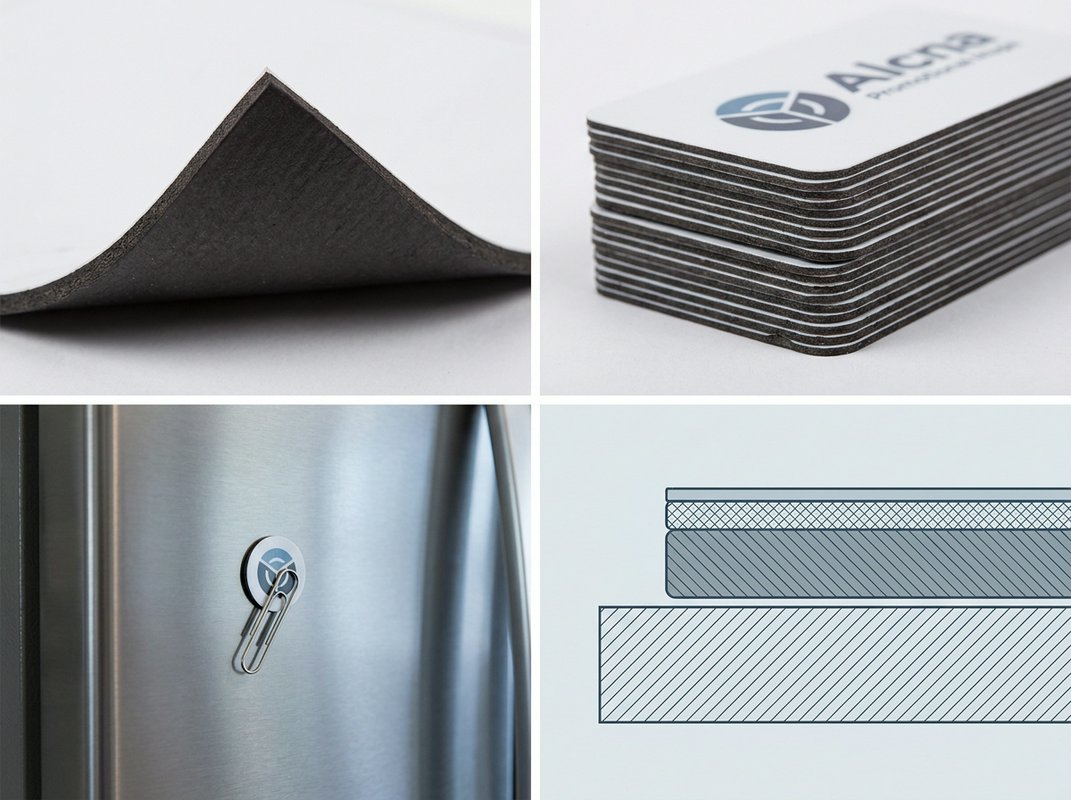
A fridge magnet is really two separate decisions bolted together: the magnetic material underneath, which does the work of holding it to the door, and the printed or moulded face on top, which is what the reader actually notices. Getting one that works means matching the first to the door it has to grip, and the second to how long you want it kept.
The material is usually one of three things: a flexible magnetic sheet (ferrite powder bound into a rubber-like sheet, the type behind most printed promotional magnets), hard ferrite (a rigid ceramic magnet, common in cheaper novelty pieces), or neodymium (a rare-earth magnet, far stronger for its size and the type used where a magnet needs to hold real weight). Thickness matters as much as material: a 0.4 mm sheet holds itself to a clean door, while 0.6 mm or 0.75 mm is what you specify if the magnet needs to hold paper as well. The full breakdown of what each material is and where it is used is in the guide on what a fridge magnet is actually made of.
None of that matters if the door itself will not take a magnet. Some stainless steel doors are finished in a non-magnetic grade, and no magnet, however strong, will hold to them. Before specifying anything, it is worth knowing which doors this affects and why.
The UK fridge magnet printer directory is built for a business specifying a printed promotional run. It lists named UK printers and suppliers, the magnet types and finishes each one produces, and what to line up side by side before you commit to an order.
Each entry sets out, where the supplier publishes them, the minimum order quantity, the magnet backing type on offer, typical turnaround and the proofing process you would go through before a run is printed, along with a note of where to check any trade body membership or company registration. Appearing in the directory is not an endorsement of any supplier; the directory page sets out its own listing criteria, worth reading before treating an entry as vetted. Treat every figure there as a starting point for a conversation, and confirm current stock, cost, minimum order quantity and lead time directly with the printer. Where a trade body membership such as the British Promotional Merchandise Association or a Companies House registration is stated, check it before committing to a large run.
This site is organised as a set of guides, covering construction, ordering specifications, safety around small magnets, and print setup. All guides lists them by topic, so you can go straight to the one that matches what you are ordering or troubleshooting. If you already have artwork ready to send to a printer, the artwork resolution checker will tell you whether it is set up at a printable size and resolution before you send it, though it checks the file you give it and can be wrong about what a printer will accept.
A list of UK printers that produce promotional and photo magnets, with what each one specifies for minimum order quantities, backing type, turnaround and proofing, so you can compare before you ask for a quote.
BlankKeyrings.co.uk is a UK trade supplier of blank acrylic and photo fridge magnets for printers, photographers, gift retailers and promotional resellers, and holds BPMA accredited membership.
Badger Design is a UK fridge magnet manufacturer and supplier based in Exeter, Devon, producing promotional and branded magnets in a range of shapes and finishes with quantities from 250 upward.
Sticker It is a UK-based online print service that produces custom printed magnets in a wide range of shapes, sizes and special-effect finishes, with free digital proofs and UK delivery.
UKPrinting.com is a UK-based in-house promotional magnet printer and supplier offering a range of printed magnets in various materials including laminated, metal, paper, plastic, PVC and bamboo, with free UK delivery and free design support.
Anchor Magnets is a Sheffield-based manufacturer of flexible magnetic sheet, pot magnets, magnetic sign grippers, neodymium disc and ring magnets, and magnetic ferrite pads, serving retailers, printers and manufacturers.
Wales-based importer, manufacturer, and supplier of neodymium and rare earth ferrite magnets alongside flexible magnetic products including magnetic tape, magnetic paper, magnetic labels, magnetic sheet, and fridge magnets, with in-house cutting services.
PrinterStudio.co.uk is a UK online print service offering custom photo magnets and save-the-date magnets in multiple sizes, made from vinyl material with a UV-coated high gloss finish.
Sticker Mule UK offers custom photo magnets in square sizes from 50 mm to 125 mm (plus custom sizes) with a matte finish, sold to UK customers with free shipping and a 4-day turnaround.
Bags of Love is a London-based personalised gift printer that manufactures custom photo fridge magnets in round and rectangular shapes, available in packs of up to 20, printed and assembled in their London workshop.
Stickers International, a trading name of J&A (International) Ltd, is a UK online print service supplying digitally printed domed fridge magnets on 0.6mm magnetic vinyl with a polyurethane resin coating.
Better Printing is a Southampton-based online print service that prints custom magnetic sheets in sizes from A6 to A0 and custom dimensions, with a choice of lamination finishes and die-cut shapes.
A file that looks sharp on screen can still print blurred, because a screen and a printed magnet measure sharpness differently. Enter your magnet's finished size and your image's pixel dimensions and the checker tells you whether it clears 300 dpi. It checks against that threshold only; it cannot see how the finished print will actually come out, so confirm anything borderline with your printer before the run goes ahead.